
Norman Kirk
This silo acknowledges a famous son of Waimate - New Zealand’s fourth Labour prime minister, Norman Eric Kirk (1923-1974)
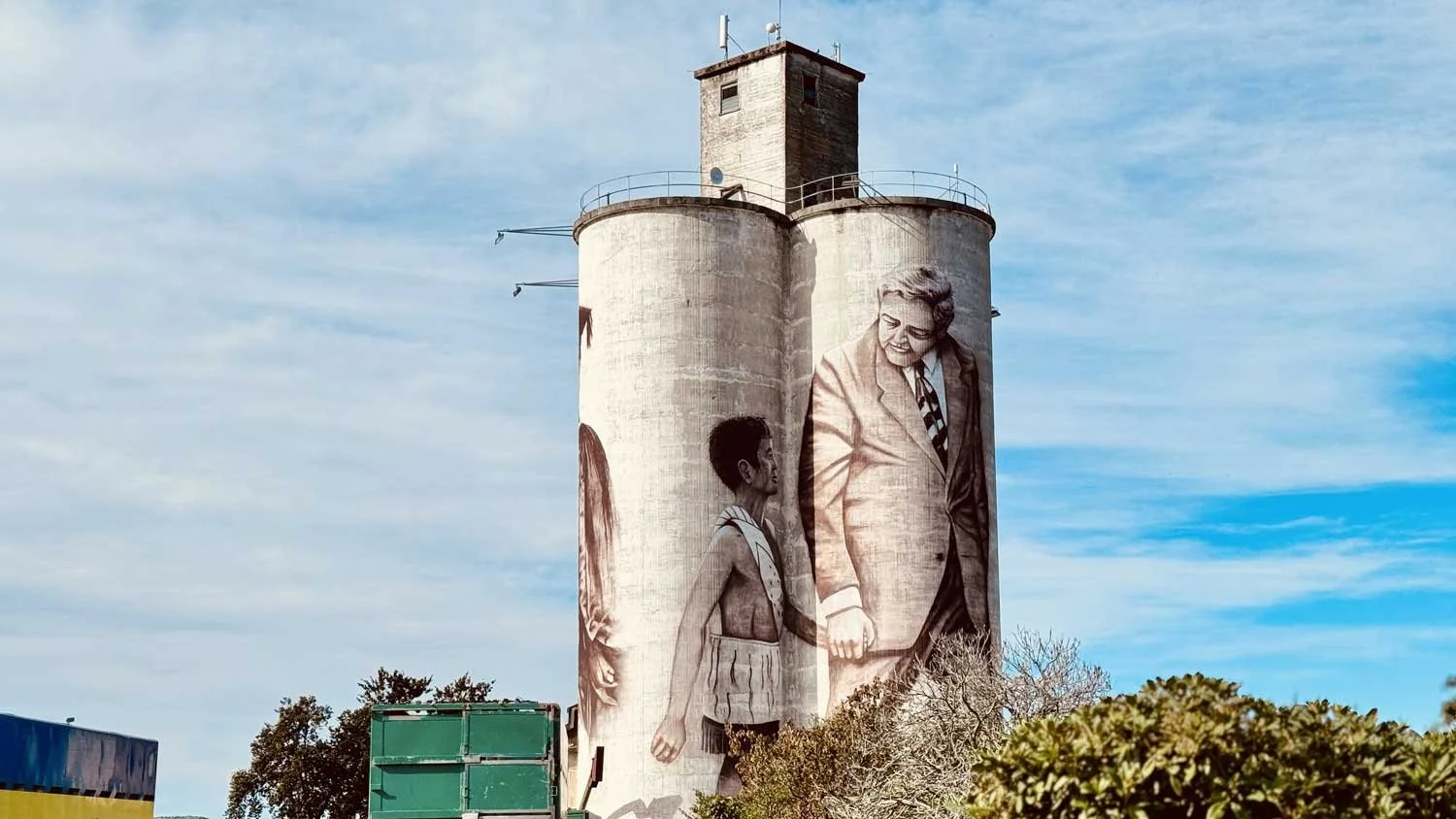
He was born in Waimate to staunch Salvation Army parents. His father, also named Norman, was a cabinet-maker.
The family left Waimate during the depression in search of work, and over the years returned for holidays with their Waimate cousins. He said, of leaving Waimate “it was always a matter for heartburning when we had to go home at the end of the holidays”.
His love of the outdoors developed from these visits. Open spaces, he claimed, reduced him to ‘proper proportions’. Milking cows, rabbit and possum hunting, and fishing were part of his life in Waimate, and he developed a passion for swimming.
Kirk was educated at Linwood School in Christchurch. He was a voracious reader and loved school for the books it gave him access to. He left school aged 12 and worked as a roof painter. At 13 he became a welder’s apprentice.
The proprietor assumed he was older. “There seemed no good reason for making the poor man unhappy by exposing his poor judgement,” Kirk told his biographer John Dunmore.
At 16 Kirk moved to the North Island and started work for NZ Railways, and at 20 was a ferryman and vice-president of the Auckland Ferryman’s Union.
He and his wife, Ruth, (later Dame Ruth) moved to Kaiapoi in 1943. They decided to build a house, but and due to tight funds and a shortage of materials after WWII Kirk built the house himself entirely, right down to the casting of the bricks. At 30 he was mayor of Kaiapoi.
Kirk became MP for Lyttelton in 1958, and leader of the opposition Labour Party in 1965. On November 25, 1972 Labour won the election and Kirk became prime minister.
The North Canterbury Gazette summed him up as a person of imagination, faith, and energy.
“He has worked for all he has, bringing to every enterprise an earnestness of approach, a quick certainty of manner, and a discrimination that are attributes of the true leader. He is content to be judged by his work…his greatest ability is his reliability. His word is his bond.”
He stressed the need for regional economic development and affirmed New Zealand's solidarity with Australia in adopting a foreign policy more independent of the United States. In 1973, he strongly opposed French nuclear tests in the Pacific. He promoted racial equality at home and abroad; his government prevented the South African rugby team from touring New Zealand during 1973.
Kirk had a reputation as the most formidable debater of his time and once famously said that people don't want much, just,
"someone to love, somewhere to live, somewhere to work and something to hope for.”
Due to his energy, charisma and powerful oratory, as well as his untimely death, Kirk remains one of the most popular New Zealand prime ministers.